
Why 3D Jacquard Logos Stand Out And Stay Put On Performance Sportswear


Table of Contents
- What 3D Jacquard Actually Is
- Woven Versus Printed Logos: A Structural Difference
- Why 3D Jacquard Logos Are Hard To Peel Off
- The Logo Is Locked Into Every Yarn
- Built To Survive Sun, Sweat, And Abrasion
- Three-Dimensional Structures Spread Out The Damage
- Why 3D Jacquard Logos Look More Prominent And Premium
- References
Rip up a rocky trail, lean hard into a berm, or grind through a long climb, and your jersey, pack straps, and chest protector all start fighting for the same square inches of fabric. On basic printed gear, that is exactly where the logo starts to crack, peel, or fade. On the latest 3D jacquard sportswear, that same high-wear zone still looks sharp after a full season.
As someone who spends a lot of time beating up performance gear in real off‑road and outdoor conditions, I pay close attention to how branding holds up. Not because I care about vanity shots, but because a logo is usually the first visible sign of how a fabric is constructed. When the logo is woven in with 3D jacquard instead of slapped on with ink, you are looking at a completely different level of durability and performance.
This article breaks down why three-dimensional jacquard makes sports logos both more prominent and far less likely to fail, drawing on textile research, performance-sports examples, and advanced fabric engineering that is already reshaping technical apparel.
What 3D Jacquard Actually Is
Jacquard is not a material; it is a weaving technique. Instead of raising and lowering big groups of warp threads together, a jacquard loom controls each warp thread individually. As Adorno Design has pointed out, that makes a jacquard fabric feel a lot like a high‑resolution screen: each yarn behaves like a pixel in the pattern.
Historically, this started with Joseph Marie Jacquard’s loom in the early 1800s, which used punched cards to automate complex patterns. Modern versions are fully computerized, as detailed by Bryden Apparel and Modaknits Apparel, so designers sketch the pattern in software and drive every thread with digital precision. The key point is that the pattern is woven into the fabric structure itself, not printed on top.
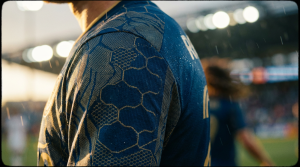
When you apply that capability to a logo and push it into three dimensions, you get a 3D jacquard logo. Instead of a flat, inked patch, the logo is formed by different yarn colors and different weave structures that create raised and recessed areas. Modaknits, Ninghow Apparel, and Haystacks all highlight this textured, three‑dimensional quality as a hallmark of jacquard fabrics.
In performance sportswear, you see this in textured team crests, vertical stripe patterns, and brand marks that you can feel with your fingertips. Marshal Sportswear describes how vertical jacquard stripes in sports tops use interlaced warp and weft yarns to build a relief or wavy texture. When light hits those surfaces, you get a play of light and shadow that feels almost animated when the athlete moves. The same principle applies when the pattern is a logo, not just a stripe.

Woven Versus Printed Logos: A Structural Difference
To understand why 3D jacquard logos resist peeling and fading, you have to look at how they are made compared with standard printed logos.
In a woven jacquard logo, the motif is part of the fabric’s skeleton. The individual warp and weft yarns change color or follow a different weave pattern exactly where the logo sits. According to Bryden Apparel and Modaknits, these designs can range from simple geometrics to photographic‑like imagery, all created by manipulating the weave itself.
In a printed logo, the fabric is woven first, then ink, paint, or a transfer layer is applied on top. Anmyda’s comparison of jacquard webbing and printed webbing spells this out: printed markings sit on the surface and are vulnerable to UV exposure, abrasion, chemicals, and temperature. Jacquard patterns, by contrast, are integrated into the webbing, which is why they do not flake or peel.
Lexa Sport makes the same point in the sportswear context. Its activewear uses jacquard fabrics where patterns and logos are woven into the fibers, not printed. The result, they note, is that logos and graphics resist peeling, cracking, and fading even after heavy use and repeated washing. Team uniforms with jacquard elements maintain a sharp professional appearance all season, instead of suffering the mid‑season fading that is common with standard printed gear.
That is the structural difference in one line: a 3D jacquard logo is yarn; a printed logo is coating.
Here is how that plays out in real-world use.
|
Aspect |
3D woven jacquard logo |
Surface‑printed logo |
|---|---|---|
|
Construction |
Logo formed by colored yarns and weave structures, integrated into the fabric itself |
Logo formed by inks, dyes, or transfer films applied to the fabric surface |
|
Visual effect |
Textured, three‑dimensional, interacts with light and shadow, premium aesthetic |
Mostly flat, relies on color and gloss rather than depth; can look “stuck on” |
|
Behavior under stress |
No separate film to crack or peel; wear happens to the same yarns that make the logo |
Coating can crack, flake, or delaminate when stretched, abraded, or exposed to harsh conditions |
|
Suitability for outdoors |
Recommended for strong sunlight, rough handling, and long‑term branding by technical sources like Anmyda and Lexa Sport |
Suitable mainly for lower‑stress, indoor, or short‑term uses as noted in printed‑webbing guidance |
Once you see logos through this lens, it becomes obvious why 3D jacquard is the go‑to choice for serious performance gear.

Why 3D Jacquard Logos Are Hard To Peel Off
The short answer is that there is nothing to peel. The long answer involves materials, structure, and how 3D fabrics handle stress.
The Logo Is Locked Into Every Yarn
Jacquard fabrics are built from tightly interlaced warp and weft yarns. Bryden Apparel notes that this weaving process produces a sturdy, tightly woven fabric that stands up well to regular wear. When the logo is part of that weave, the branding shares the same backbone as the fabric itself.
Anmyda explains that in jacquard webbing, patterns and markings are woven directly into the structure. Because of that, the appearance and legibility of branding on the webbing remain stable for the life of the product. They specifically contrast this with printed webbing, which they say can degrade or even fail structurally within months in harsh conditions.
Translated to sportswear, a jacquard logo does not have an adhesive layer or film to separate under tension. To damage the logo, you would have to cut, fray, or wear through the yarns that are also holding the garment together. That is a fundamentally different failure mode from a print that can flake away while the underlying fabric is still sound.
Built To Survive Sun, Sweat, And Abrasion
Outdoor and high‑intensity use throws a brutal mix of stress at your gear: strong sunlight, sweat salts, mud, detergents, backpack straps, seatbelts, and crash impacts. This is exactly where jacquard shines.
Anmyda describes jacquard webbing as superior in demanding environments, emphasizing its resistance to UV exposure, chemicals, abrasion, and temperature extremes. They recommend jacquard over printed alternatives wherever long‑term durability and the legibility of branding or safety markings are critical. When printed webbing is used instead, they warn it can fail within a matter of months under heavy UV, chemical, or mechanical stress.
Lexa Sport echoes this for clothing. Their jacquard sportswear is pitched as lightweight and breathable but still tough enough to hold design details through intense training and frequent washing. Because the logo is woven in, it resists the peeling and cracking that you commonly see on surface prints.
Suerte Fabric provides a sense of the durability ceiling here. For jacquard mesh fabrics used in contract and performance contexts, they cite around 15,000 to 30,000 Wyzenbeek double rubs and 20,000 to 40,000 Martindale cycles. Those are abrasion tests designed to simulate real‑world wear. When a logo is part of that jacquard mesh rather than a separate film, it inherits the same abrasion resistance.
That is why, after months of riding with pack straps grinding across your chest, a 3D jacquard logo still reads clean, while a printed version might be a cracked ghost of its original art.
Three-Dimensional Structures Spread Out The Damage
3D fabrics add a little engineering twist. Style3D’s overview of 3D textiles notes that multi‑layer, three‑dimensional architectures can deliver significantly higher strength and impact resistance, with some structures showing around a 50 percent improvement over conventional flat textiles. They also highlight 3D spacer knits and hollow structures that add cushioning and maintain airflow.
Suerte Fabric’s jacquard mesh is a perfect example. It combines complex jacquard patterning with a porous mesh structure to deliver strong airflow and elasticity while holding embossed textures. The fabric stays light and breathable, yet durable enough for running, cycling, and heavy gym use.
When the logo is carved into that kind of structured, three‑dimensional surface, stress gets shared across multiple yarn layers and directions. Instead of a brittle printed film taking all the abuse, the woven pattern distributes it through the fabric body. That is another reason these logos tend to age gracefully rather than failing catastrophically.

Why 3D Jacquard Logos Look More Prominent And Premium
Durability is only half the story. The other half is visual punch. On high[2025-11-29T12:00:47] stream error: stream disconnected before completion: Transport error: error decoding response body; retrying 1/5 in 203ms…

References
- https://www.academia.edu/114739538/Single_sided_Jacquard_knit_fabric_development_and_seamless_ski_underwear_zoning_design_based_on_body_mapping_sportswear
- https://repository.lib.ncsu.edu/bitstreams/ffec0d72-023f-4bb2-83ac-dcdbfd57d9e0/download
- https://itp.nyu.edu/adjacent/issue-7/is-wearable-technology-ready-to-wear/
- https://www.haystacks.net/blogs/informative/what-is-jacquard-fabric-a-complete-beginners-guide
- https://idj.journals.ekb.eg/article_332563_833755d5c5d14c96b046b02be3c36441.pdf
- https://anmyda.com/when-to-use-jacquard-webbing/
- https://brydenapparel.com/jacquard-fabric/
- https://www.marshalsportswear.com/news/introduction-of-jacquard-fabric-84014932.html
- https://modaknits.com/jacquard-fabric/
- https://suertefabric.com/jacquard-mesh-fabric-style-performance-fashion-sportswear/

RELATED ARTICLES


Ready to start your sportswear brand?
Get a free quote for custom sportswear manufacturing with no minimum order quantity.